
Content
A semi-tubular rivet with a 2 mm shank often carries the full articulation of a laparoscopic scissor or a biopsy forceps jaw. It costs a few cents on the bill of materials and sits among the highest-risk parts in the design file: if the medical device rivet is too hard, the joint seizes; if it is too soft, the jaws develop play after repeated autoclave cycles; if the alloy is wrong, the same rivet becomes a corrosion site and a biocompatibility question in a single revision.
Most sourcing teams meet that problem late, usually when a first-article sample that passed bench testing comes back from sterilization validation with a torque value outside the drawing. The geometry of the rivet was never the difficult part. The difficult part is material pedigree, hardness range, surface condition, and the setting process.
A medical device rivet is a permanent fastener specified for a medical device assembly, and it is defined less by its shape than by its evidence: certified material, controlled hardness, documented cleanliness, capable dimensions, and an installation process that can be repeated under audit.
A medical device rivet is a cold-headed or machined fastener whose alloy, hardness, dimensions, surface condition, and setting parameters are specified to the quality system of a medical device manufacturer, so that every finished joint can be validated, traced to a heat number, and reproduced across production lots.
Physically, the part may be indistinguishable from a commercial semi-tubular rivet. The difference shows up in four places:
Remove any one of those four and the rivet turns into a non-conformance waiting for the next supplier audit.
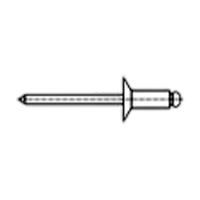
Semi-tubular rivets cover most articulating joints in reusable instruments, solid rivets take structural and shear loads, and tubular and blind rivets handle eyelets, housings, and assemblies that can only be reached from one side.
| Rivet type | Joint function | Typical medical use | Setting method |
| Semi-tubular | Pivot or controlled compression | Scissors, forceps, retractors, clamps | Orbital or impact |
| Tubular and eyelet | Ducts material, low-profile bushing | Electrode contacts, cannula liners, connector shells | Orbital or spin |
| Solid | Highest shear strength, permanent joint | Instrument frames, handles, sterilization trays | Impact press |
| Blind, break mandrel | One-sided access, sealed or open end | Device housings, disposable enclosures | Hand or pneumatic tool |
| Drive | Fast setting, low clamp load | Covers, panels, non-sterile hardware | Mallet or press |
| Custom cold-headed | Geometry written around one joint | OEM articulating mechanisms | Per validated process |
If the joint has to pivot, the rivet must roll a head without pulling the two parts into hard contact. If the joint has to hold two plates in permanent compression, a solid rivet or a shoulder screw is usually the better answer.
316L stainless steel is the default alloy for a medical device rivet. It cold-heads cleanly, resists steam and ethylene oxide sterilization, and is available with full traceability from wire to finished part. Titanium grades take over where weight, MRI behavior, or galvanic isolation matter, and high-strength alloys such as MP35N are reserved for joints that have to survive millions of load cycles.
Strength alone rarely settles the material question. A harder alloy can produce a worse pivot joint, because a hard shank will not roll into a controlled head on a thin 1.5 mm section. That is why the highlighted 316L row stays the workhorse despite being roughly half the tensile strength of Ti-6Al-4V.
Sterilization decides more designs than load does. Steam autoclave cycles at 134 C drive chloride stress corrosion in the wrong stainless grade, gamma radiation at typical 25 to 40 kGy doses passes through 316L and titanium without meaningful loss of strength, and repeated ethylene oxide cycles leave residues that must be cleared to ISO 10993-7 limits.
Passivation is a process step with its own validation. ASTM A967 lists several routes, and switching from nitric acid to citric acid changes the surface chemistry of a finished rivet enough to require re-validation of the joint.
Two numbers decide most rivet joint failures: the diametral clearance between shank and hole, and the hardness range of the shank. Everything else is secondary.
Acceptance for a pivoting rivet joint is measured on the joint: torque, play, and head height after setting. The rivet's own drawing dimensions are only half of the specification.
Rivet suppliers are judged by documentation as much as by parts. Since 2 February 2026, the FDA Quality Management System Regulation aligns 21 CFR Part 820 with ISO 13485, which makes supplier records part of the device maker's own compliance surface.
Change control is the clause that causes the most pain. A supplier that switches wire mill, temper, or plating chemistry without notice invalidates the customer's process validation, even when every incoming sample still passes inspection.
One qualified supplier is one point of failure. Medical rivet programs stay stable when the drawing is frozen before sourcing starts and two suppliers are qualified against the same specification.
The cheapest rivet in the catalog becomes the most expensive part in the device the day an audit finds an untraceable lot.
316L stainless steel covers the majority of applications because it cold-heads well, accepts passivation, and survives steam, ethylene oxide, and gamma sterilization. Titanium Grade 2 and Grade 5 are used where weight, MRI compatibility, or galvanic isolation matter, and MP35N appears in high-cycle joints.
Yes, provided the supplier can hold the specification. The part must meet the device's biocompatibility and cleanliness requirements, carry lot traceability, and be installed by a validated process. Most commercial rivet lines cannot supply heat-level documentation or change control, and that is what disqualifies them.
Set the hole tolerance first, H9 or H10 for a pivoting joint, then specify the diametral clearance, the shank hardness range, and the roll head height. Finish with a functional requirement on the assembled joint, such as articulation torque of 0.02 to 0.2 newton metres and a maximum axial play of 0.1 mm.
Rivets appear mostly in instruments, delivery systems, and sterile packaging hardware rather than in long-term implants. When a rivet does enter an implantable assembly, the alloy must be implant grade, the surface must meet the relevant ISO 10993-1 testing category, and the setting process must be validated for that specific device.
Match the rivet to the joint, document the joint, then qualify two suppliers against the same drawing. That order keeps a two-cent part from holding up a device release.



 English
 Español
 عربى