

Content
Every threaded fastener joint faces the same enemy over its service life: gradual loss of clamping force caused by vibration, thermal cycling, or surface settling. Lock washers were developed to fight that loss by generating spring pressure and, in toothed designs, by digging into the mating surfaces to resist rotation. Within the toothed family, two geometries dominate industrial and consumer hardware catalogs: the external tooth lock washer, with teeth bent outward around the rim, and the internal tooth lock washer, with teeth angled inward toward the bore. Both accomplish the same broad task, yet the placement of those teeth changes how force is applied, where contact happens, and which joints each design suits best.
This distinction matters more than it first appears. A fastener engineer choosing between the two is not picking a cosmetic variant; they are selecting where on the washer face the bite will occur, how much of the mating surface will be marked, and how the washer behaves under repeated torque and vibration. Understanding tooth placement, load distribution, and design intent allows a purchaser or designer to match the correct washer to the correct joint instead of defaulting to whichever part happens to be on the shelf.
The confusion between the two designs is understandable because, from a distance, both look like a metal ring with a serrated edge. It is only when a person picks one up and turns it in the light that the direction of the teeth becomes obvious, and even then, the practical consequences of that direction are not always intuitive without some background in how clamped joints actually fail. A bolted or screwed joint rarely loosens because the fastener itself unscrews on its own accord under a steady, unchanging load. More often, loosening starts with a small amount of relative motion between the fastener head, the washer, and the surface underneath it, often triggered by vibration, thermal expansion and contraction, or a slight settling of the clamped materials shortly after assembly. Once that first sliver of motion appears, friction at the mating surfaces drops just enough for the fastener to begin rotating in tiny increments, and each increment compounds until the joint has measurably lost clamping force.
Toothed lock washers interrupt that chain of events by giving the joint a mechanical purchase point in addition to the friction that would otherwise be doing all of the work. Instead of relying purely on surface friction between the bolt head and the washer, or the washer and the substrate, the teeth physically bite into both surfaces, creating small mechanical interlocks that resist the very first sliver of rotational motion before it can begin. Because that first sliver of motion is what starts the loosening cascade, stopping it early has an outsized effect on long-term joint reliability compared with what the small size of the teeth might suggest.
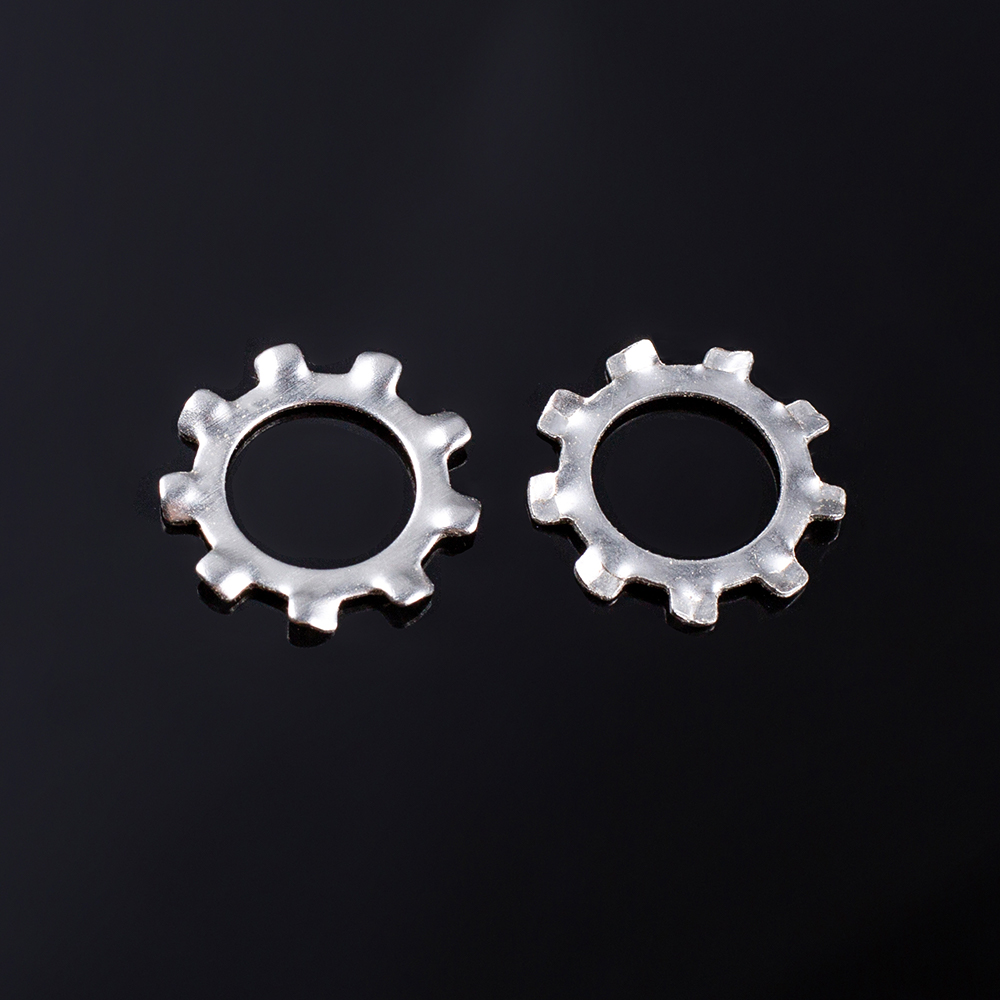
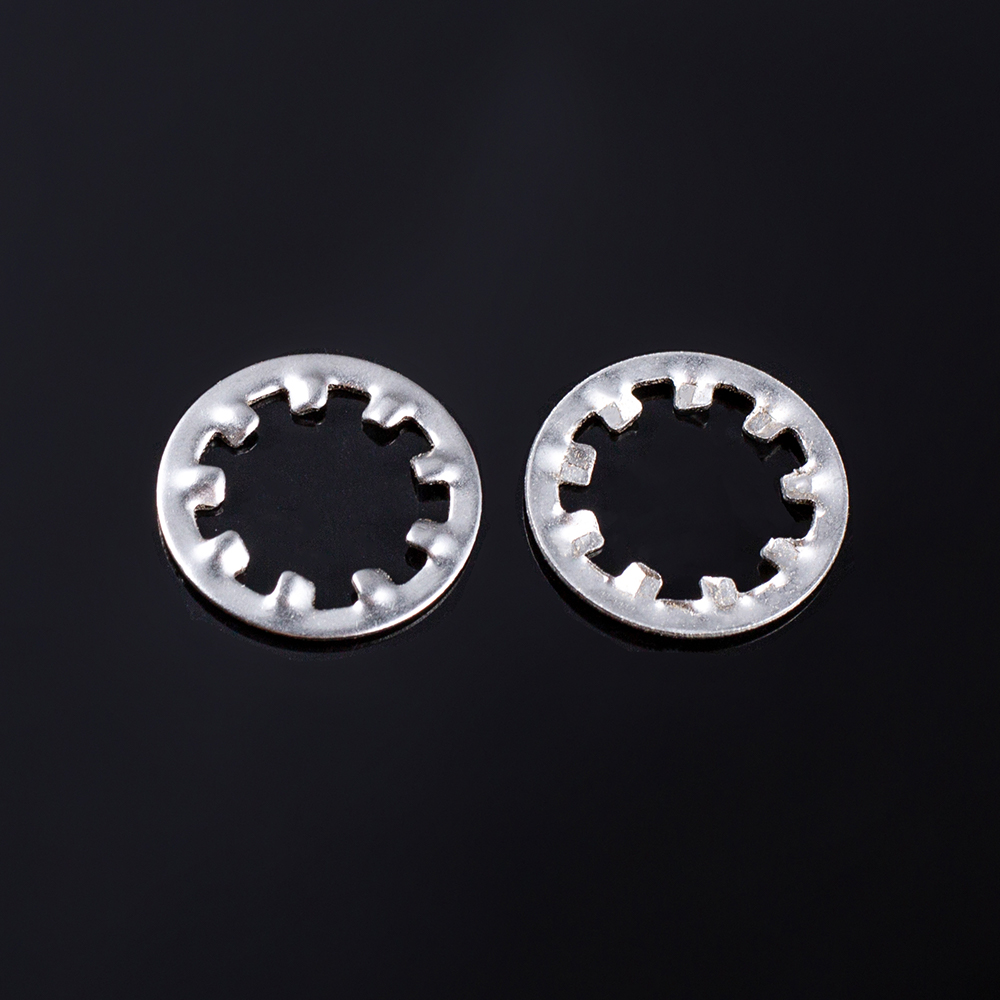
The core physical difference between the two washer types is simple to state but has wide-ranging consequences. An external tooth washer has teeth formed along its outer diameter, twisted so each tooth presents a sharp edge that angles slightly out of the washer plane. An internal tooth washer flips that arrangement: the teeth are stamped along the inner diameter, close to the bolt shank or screw body, and angle inward.
Because the external tooth washer bites at the outer rim, it engages a wider circle of contact against the bearing surface underneath the bolt head or nut. That wider circle spreads resistance to rotation across a larger arc, which tends to help most on flat, softer materials such as sheet metal enclosures, painted panels, or lighter alloy housings. The internal tooth washer, by contrast, concentrates its bite immediately around the shank, which keeps the outer face of the washer relatively unmarked and is often preferred where the visible surface finish around the fastener matters, such as on decorative panels, appliance housings, or joints where the outer rim sits close to another component and cannot tolerate protruding teeth.
The number and angle of the teeth also play a supporting role. Most stamped designs place between eight and a dozen teeth around the ring, each twisted slightly out of plane so that under compression they act like small cantilevered springs as well as cutting edges. As the fastener is tightened, the teeth first flatten slightly, storing spring energy, and then bite into the surface as full clamping force is reached. This dual action, part spring and part cutting edge, is why toothed washers are sometimes grouped in the broader lock washer family alongside split ring designs, even though the loosening resistance mechanism is meaningfully different. A split ring washer relies almost entirely on stored spring tension pushing back against the fastener threads, while a toothed washer adds a mechanical bite on top of whatever spring tension the stamping process provides.
Material selection interacts with tooth placement as well. On a harder substrate such as thick structural steel, both external and internal tooth designs will struggle to bite deeply, and the practical performance difference between them narrows because neither design achieves a deep purchase into the base material. On a softer substrate such as aluminum sheet or a painted enclosure panel, the difference becomes far more pronounced, since the teeth can actually sink into the material rather than merely scoring the surface. This is one reason experienced assemblers treat tooth washer selection as a joint-specific decision rather than a blanket standard applied across every fastener in a design.
Load distribution is where the practical consequences of tooth placement become clearest. A washer under a tightened fastener is not just resisting rotation; it is also spreading the clamping force of the bolt head or nut across the underlying material so that stress does not concentrate in one small point. The diameter at which the teeth make contact changes the radius of that spread.
Because external teeth sit at the largest available diameter for a given washer size, they distribute the bite over a wider circumference, which lowers the pressure at any single tooth for the same clamping force. Internal teeth, positioned at a smaller radius, concentrate more force per tooth for the same torque, which increases local bite depth but also increases the risk of surface marking directly around the bore on harder or thinner materials.
These figures are illustrative rather than laboratory measurements, but they represent a pattern consistently observed in joint assembly practice: washers with a wider contact bite spread clamping stress across a larger footprint, which reduces the chance of the underlying surface deforming or the fastener sinking into softer material over time.
Load distribution also has a secondary effect that is easy to overlook: it influences how evenly the clamped parts sit against one another once the joint is fully torqued. A washer that concentrates its bearing pressure into a narrow ring can create a slight rocking tendency if the surrounding surface is not perfectly flat, because the load path funnels through a small contact band rather than being cushioned across a broader area. A wider bearing footprint tends to average out small surface irregularities, which is part of why external tooth designs are often specified on assemblies where the mating panel may have minor waviness from manufacturing tolerances, such as stamped sheet metal covers or extruded housing sections.
There is a trade-off worth noting, however. Spreading the load over a wider area lowers peak pressure at any single tooth, which is good for avoiding surface damage but can also mean a shallower average bite depth compared with a design that concentrates the same clamping force into a smaller ring. This is the core mechanical trade-off between the two washer types: external tooth designs favor broad, gentle engagement suited to protecting the surrounding surface, while internal tooth designs favor a tighter, more concentrated bite suited to resisting rotation in a smaller footprint. Neither approach is universally stronger; each simply shifts where on the pressure-versus-area curve the joint sits.
Both tooth designs are marketed primarily on their ability to resist loosening under vibration, but the way each holds up over extended cycling differs slightly because of where the bite occurs relative to the fastener axis. Teeth positioned closer to the bolt shank on an internal tooth washer sit nearer the pivot point of any rotational micro-movement, giving them a mechanical advantage in early-cycle resistance. Teeth positioned farther out on an external tooth washer benefit from a longer lever arm, which can translate into steadier long-term retention once the initial bite has set into the surface.
The curves shown here reflect a generalized pattern seen across many joint studies rather than a fixed guarantee: internal tooth washers often start with a slightly stronger early bite because of the shorter lever arm near the shank, while external tooth washers tend to degrade more gradually because their wider bite radius resists rolling loose even after individual teeth have partially worn. Neither pattern makes one design universally superior; the right choice depends on whether the joint is expected to see intense early vibration, such as during initial equipment run-in, or steady long-term cycling, such as continuous operating machinery.
Toothed washers are also not meant to compensate for a poorly specified fastener. If the bolt or screw diameter is undersized for the load, or the clamped materials are too soft to hold torque at all, no amount of tooth geometry will fully offset that mismatch. They are a refinement layered on top of an otherwise correctly sized joint, not a substitute for correct fastener sizing.
Fastener design choices rarely come down to a single property. Engineers weigh surface hardness, visibility of the finished joint, available radial clearance, and expected vibration profile together. The table below summarizes common decision points drawn from general assembly practice.
| Consideration | External Tooth Washer | Internal Tooth Washer |
|---|---|---|
| Bite radius | Outer rim, wide circumference | Inner bore, close to shank |
| Surface marking | Wider ring of light marking | Small ring close to bore |
| Best on | Soft or thin sheet materials | Harder, thicker mating parts |
| Visible finish impact | More noticeable at rim | Mostly hidden under bolt head |
| Typical use | Panel enclosures, brackets | Electrical terminals, small assemblies |
| Clearance need | Requires rim space | Fits tighter bore areas |
Enclosures and structural brackets, which are frequently made from thinner sheet stock, lean toward external tooth designs because the wider bite spreads clamping force without deforming the panel. Electrical terminals and compact housings, where the visible face must stay clean and space around the bore is limited, lean toward internal tooth designs. Neither pattern is a strict rule; it reflects the general logic that guides selection once the two mechanical behaviors are understood.
Grounding and bonding joints are one of the more common places where tooth washers appear outside general structural fastening. Because the teeth cut through light surface oxidation as they bite, both designs are commonly specified in bonding applications, with the choice usually driven by available space around the terminal lug.
A single number rarely tells the full story of a fastener component, so a multi-attribute comparison is often more useful during the selection process. The radar chart below plots five attributes commonly weighed against each other: vibration resistance, surface protection, edge bite strength, ease of alignment during assembly, and general cost efficiency at typical production volumes.
External tooth washers tend to score higher on vibration resistance and cost efficiency, since the wider bite radius resists loosening well and the stamping process for outer teeth is generally simpler at volume. Internal tooth washers tend to score higher on surface protection and ease of alignment, since the smaller outer profile keeps the rim clear of surrounding hardware and the teeth self-center more naturally around the shank during assembly. Edge bite strength runs close between the two, with the advantage shifting depending on the hardness of the mating material.
Reading a chart like this is most useful when the attributes are weighted according to the specific joint being designed rather than treated as equally important across every application. A designer working on an outdoor structural bracket, where vibration resistance and long-term reliability outweigh cosmetic concerns, will naturally lean toward the attributes where external tooth designs score higher. A designer working on a compact electronic enclosure, where the visible seam around each screw matters to the finished product and available radial space is tight, will weight surface protection and ease of alignment more heavily and lean toward internal tooth designs instead. The chart is a starting point for that conversation, not a final verdict, since real projects usually balance several of these attributes against each other simultaneously rather than optimizing for just one.
Selecting the correct tooth geometry is only half of a successful joint. A few practical checks reduce the chance of a washer underperforming once installed:
These checks are common practice across general assembly work and apply regardless of which tooth geometry is ultimately selected. Skipping them is a more frequent cause of joint loosening than choosing the wrong washer type in the first place.
They are typically used one at a time rather than stacked, since each is already designed to provide sufficient bite on its own and stacking adds unnecessary joint height without a proportional gain in holding power.
Tooth placement mainly affects how the clamping force is distributed once the fastener is tight rather than the torque required to reach that clamping force, though slightly higher friction can occur as the teeth begin to bite.
They can be used on coated surfaces, but the teeth will typically break through the coating at the contact points, which is expected behavior since the bite depends on reaching the base material underneath.
Internal tooth washers tend to self-center more easily around the bolt shank, which can slightly speed up alignment during repetitive assembly compared with the outer rim contact of external tooth designs.
They reduce the likelihood of loosening from vibration but are not a substitute for thread-locking compounds in joints where chemical retention is specifically required by the application.






 English
 Español
 عربى
عربى